

Bridging Corporate Strategy and Successful Execution


1. The Problem
Strategies describe where an organisation wants to go, but they only deliver value when translated into concrete actions. In many organisations, a persistent gap opens between strategic ambition and operational reality: strategies are formulated at the top, while decisions about projects, systems, and processes are made day to day - often reactive, fragmented, or implicit [1][2]. In an era of digital transformation, this tension intensifies: technology shifts compress strategic cycles, regulatory frameworks evolve faster than organisations can adapt, and the pressure to digitise processes and systems adds a layer of structural complexity that makes even well-crafted goals fail in execution.
A business strategy is not an operational plan but a long-term frame of reference. It sets goals, priorities, and organisational positioning, and is meant to focus action and reduce complexity. Its value is only realised, however, when that orientation is systematically translated into concrete operational decisions. As Mintzberg and Waters demonstrate, an organisation's realised strategy frequently diverges substantially from what was intended - a finding that makes the structural translation work a task in its own right [3]. Requirements Engineering can close that gap. But first, it helps to understand why the gap opens — and why closing it is harder than it looks.
What value does a strategy create?
An explicit strategy clarifies organisational intentand gives everyone a shared direction. It enables more targeted resource allocation, clearer priorities, and prevents contradictory activities. Organisations with a clear strategy are better positioned to spot opportunities, assess risks, and justify decisions.
A strategy also increases connectivity across organisational levels: it connects leadership, business units, and operational execution through a common frame of reference. In complex environments where many actors with different perspectives must work together, this connective function is critical. But it is not a given - it has to be actively built. And that is precisely where many organisations fail: not in formulating the strategy, but in translating it structurally into decisions, processes, and systems.
What shapes a strategy?
A viable strategy does not emerge in a vacuum. It draws on two kinds of understanding: the external environment - market conditions, regulatory frameworks, technology shifts, and competitive dynamics - and the organisation itself, meaning its internal structures, capabilities, processes, culture, and resources. Only those who understand both dimensions can judge which strategic architecture is actually feasible [9].
Ready or not?
Once an organisation formulates a new or revised strategy, a practical question arises immediately: can the strategy actually be executed? If the answer is no, announcing the strategy is not enough. The organisation has to be made ready first – through adjustments in processes, roles and responsibilities, competencies, IT systems, and governance structures.
Getting ready requires genuine self-knowledge: What do stakeholders actually need? How do processes really work? Where are the breaks, conflicts, and bottlenecks? Without that understanding, adaptations risk being made blindly – generating new problems while supposed solutions miss the actual root causes [4].
Why strategies fail in practice
Despite good intentions and clearly stated goals, strategies fail regularly [1][2]. The symptoms tend to look like this:
- Technically sound but strategically irrelevant systems: IT solutions are successfully deployed but contribute nothing visible to strategic goals.
- Misallocated resources: investments flow into projects whose strategic value is unclear or turns out to be marginal.
- Implicit decisions: priorities are set by time pressure, habit, or power dynamics. Conflicts between goals go unspoken and are never addressed systematically.
- Divergent interpretations: the same strategic goal means different things to different parts of the organisation. Without a shared operational definition, everyone acts according to their own understanding - and the organisation pulls in multiple directions at once.
These symptoms point to a single underlying problem: there is no methodical bridge between the strategic level and operational execution. The principles and practices of Requirements Engineering can provide that bridge.
2. From Static Structure to Controlled Transformation – Requirements Engineering for Bridging the Gap
To understand why this translation is so difficult, it helps to look at the structural starting point of most organisations. An organisation in the tension field of strategy, value creation, and system landscape can be described structurally:
External forces, markets, competition, and regulatory frameworks act on it from outside. Internally, value creation processes are designed and technically supported by a historically grown application and data landscape. In this configuration, strategy, processes, and systems exist in a relative equilibrium.

This representation is static, however. It shows how an organisation is structured - not how it changes. As long as the strategic direction remains stable, processes and systems can operate within that framework. When strategy shifts - driven by new market demands, changing priorities, or regulatory requirements - that equilibrium starts to break down.
New strategic goals create adaptation pressure across several tightly coupled areas: customers and channels, services and partners, processes, systems, and the underlying infrastructure. An organisation is not a linear construct - it is a sociotechnical system. Changes in one area produce effects across other areas of the system [10]. What sociotechnical systems need is not more coordination, but a structured translation logic that makes interdependencies explicit before decisions are made - not after. Without systematic translation, local solutions emerge: processes are adjusted, systems extended, interfaces added - typically in isolation and under time pressure. Strategic intent is gradually lost in a series of operational detail adjustments.
Requirements Engineering as the mechanism of transformation
This is precisely where the principles of Requirements Engineering become effective as a structured mechanism for transformation and governance [11]. RE translates strategic goals into verifiable requirements for the organisation, its processes, and its systems [4][5]. It makes dependencies visible, exposes goal hierarchies, and forces implicit assumptions to be made explicit.
While strategy defines what needs to be achieved, RE provides the structured approach to ensure that decisions about how to achieve it are made transparently - not by replacing judgement, but by making the basis for it explicit. It connects the strategic level with the value creation path and the underlying system landscape, so that strategic goal changes can be analysed systematically rather than absorbed diffusely into the organisation [8].
Strategy execution is not a question of launching more projects or modernizing technology. It is a question of systematically translating strategic goals into operational design - and that is the operational strategy work of RE.

3. From Strategy to Requirement — Analytical Depth Instead of Interpretation
Strategic goals operate at a different level of resolution. They are meant to provide direction - not to predetermine operational detail decisions.
Decomposing strategic goals
The first step is the systematic decomposition of strategic goal statements to expose what they actually imply: which processes, roles, or systems are affected, what assumptions underlie the goal, and what would make achievement verifiable.
A simple example illustrates the difference: the strategic goal “increase efficiency” sounds clear — but it is worthless for operational decisions as long as key questions remain unanswered: Which dimension of efficiency is meant — throughput time, resource consumption, error rate? Which process is specifically in scope? How will improvement be measured? Which systems or roles need to be adapted? Only when these questions are answered does an abstract goal become a manageable requirement. Through this decomposition, operational building blocks emerge that are grounded in the actual processes and systems of the organisation. Step by step, abstract strategy becomes something teams can actually work with — a shared, explicit basis for decisions rather than a set of interpretations everyone fills in differently.
Transparency across Goal Hierarchies
Strategies rarely consist of isolated goals. They form goal systems with superordinate and subordinate relationships. Individual operational measures may support several strategic goals — or compete with others. Without that transparency, familiar failure modes appear: teams optimise locally, sub-goals take on a life of their own, and operational metrics quietly crowd out strategic impact.
Requirements Engineering brings structure to this: it organises strategic goals into a traceable hierarchy — from high-level guidelines down to concrete requirements. This structure makes visible what contribution is expected from each measure and how operational decisions are linked to strategic intent.
Transparency across dependencies
Strategic changes rarely affect only one area. Processes interlock, systems are coupled, data flows run through the entire organisation. A change in one area can produce unexpected effects elsewhere. Without systematic analysis, local optimizations generate systemic side effects: processes get adapted in isolation, systems extended without anyone asking what that means for the organisation as a whole.
Systematically translating strategic goals into requirements forces these dependencies to be analysed explicitly - making visible revealing which areas must change together, how technical constraints influence strategic options, and which organisational adaptations are prerequisites for system changes.
Deliberate decisions on trade-offs
Strategic goals are often in tension with each other. Efficiency gains can collide with quality standards. Standardisation can restrict flexibility. Investment restraint can slow innovation capacity. Such conflicts do not disappear when ignored — they migrate into operational detail decisions, where they are resolved implicitly, frequently under time pressure and without strategic context.
Requirements Engineering brings these trade-offs to the surface. By explicitly deriving requirements from strategic goals, goal conflicts become visible and open to discussion. Decisions no longer get buried at the system or process level — they are made deliberately, on a strategic basis. Strategy is not merely formulated; it is governed [7].
From goal to verifiable requirement
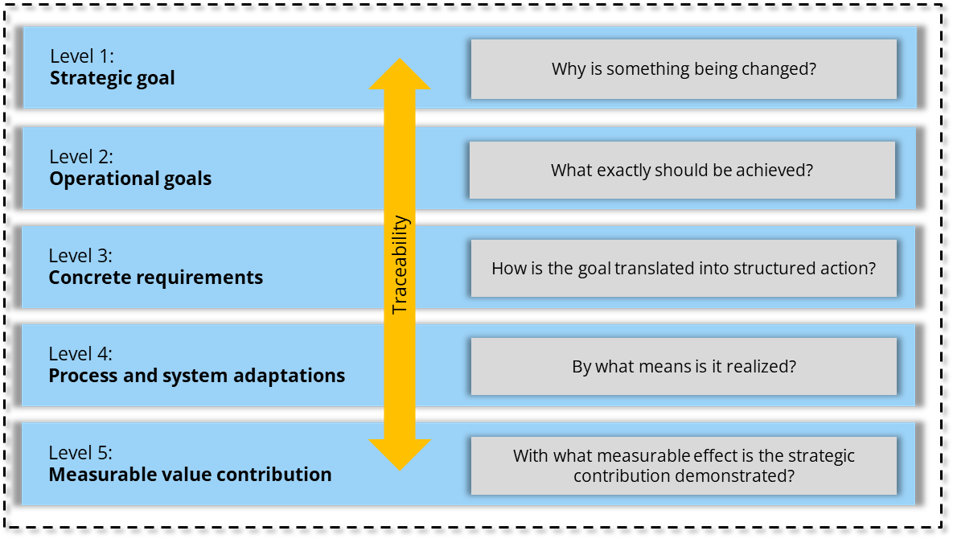
At the end of this process, requirements have a clear strategic address: they can be traced to a goal, their fulfilment can be checked, and their contribution to value creation is visible. Only in this form can strategic goals become operationally effective. Projects, process adjustments, or system developments can then no longer be evaluated in isolation, but in the context of their strategic function. Strategy stops being an abstract guiding idea and becomes something the organisation can actually use for decision-making.
The property that every requirement can be traced back to its strategic goal is called traceability [4]. Traceability is not a documentation artifact — it is a decision-making instrument: it makes visible whether a measure genuinely contributes to the strategy, and shifts the discussion from "What is feasible?" to "What actually serves our strategy?". Goal modeling and structured validation techniques can support this process systematically [6].
The decision architecture that RE builds links each level to a concrete question — from the strategic rationale down to the measurable contribution.
4. From Concept to Practice – What RE Work Means in a Strategic Context
But what does this mean in practice? RE does not begin once the strategy is set. It starts with the question of whether the organisation is capable of executing it at all — and that question should be addressed at the beginning of any strategic initiative, not at the end. RE in a strategic context is a continuous analytical process. It begins with the question of whether an organisation is even capable of implementing its strategy, and does not end with the formulation of requirements but with their tracking through projects, processes, and systems. This process is iterative: strategies change, conditions shift, and insights from implementation feed back to the strategic level.
Two characters form RE in a strategic context:
Analyst
As an analyst RE skills help structure strategic goals systematically: decomposing abstract goal formulations, surfacing assumptions, identifying dependencies, and translating the result into verifiable requirements. This work demands methodological skill and a deep understanding of the organisation - how it operates, how it is structured, and what its system landscape looks like.
Translator
As a translator, RE skills bridge different stakeholder perspectives and ensure that goal conflicts are negotiated openly - translating strategic goals into something operational teams can work with, and carrying operational realities back into the strategic dialogue. Strategic decisions are made in groups with divergent interests and different vocabularies: a CFO thinking in investment cycles, a clinical lead thinking in patient pathways, an IT architect thinking in system constraints. Where these skills are present, they create the structured space in which those differences become productive — by making sure everyone is answering the same question, not three different versions of it.
These two characters become concretely visible in the case study in Part 2. For RE skills to fulfil this function effectively, they need to be embedded in strategic decision-making processes - as an integral component of transformation governance. Organisations that systematically develop these skills gain a more robust foundation for strategic governance - and, almost incidentally, clearer requirements.
The structural picture from chapter 2 showed this from the outside — as a system under pressure. From the inside, the same tension feels like this:
In this context, an organisation can be described like a building: strategy forms the roof — it provides direction and protection, but is only as sound as the foundation on which it rests. The foundation is the operational reality of the organisation: its processes, roles, systems, and the decision logics embedded within them. If the roof is changed — that is, the strategy is realigned — without examining and adjusting the foundation, a structural tension arises. The building appears stable from the outside, but can no longer bear the load internally. RE skills are the load-bearing connection between roof and foundation: they translate strategic goals into solid requirements for processes and systems — and thereby ensure that the organisation builds a foundation the strategy can actually rest on.
5. Preview: Part 2
RE is not a cure-all: it requires the organisation to be willing to make implicit assumptions explicit and work through goal conflicts openly. That willingness is not a given. People resist explicitness - not out of bad faith, but because making assumptions visible also makes them contestable, and making goal conflicts explicit means someone has to decide. Without that organisational and human readiness, even the best RE will have no impact.
The second part of this series illustrates the logic described above through a constructed case study from the German healthcare sector. Using the example of a medical clinic, it shows how strategic goal changes trigger structural adjustments in processes, organisation, and system landscape. It traces how the two RE characters, analyst and translator, help make those changes transparent, deliberate, and coherent. The focus is not on methods or tools, but on how transparency emerges, how goal conflicts are made explicit, and how strategic decisions are translated into operational reality.
References
-
Empirical foundations (the strategy gap)
- [1] Bain & Company (2024): 88% of Business Transformations Fail to Achieve Their Original Ambitions. Press release, 15 April 2024. bain.com/about/media-center/press-releases/2024/88-of-business-transformations-fail-to-achieve-their-original-ambitions-those-that-succeed-avoid-overloading-top-talent - last visited: August 2026
- [2] Sull, D., Homkes, R. & Sull, C. (March 2015): Why Strategy Execution Unravels—and What to Do About It. Harvard Business Review
researchgate.net/publication/289998893 - last visited: August 2026
Requirements Engineering – foundations and theory - [4] Pohl, K. (2025): Requirements Engineering: Fundamentals, Principles, and Techniques. 2nd edition, Springer, Berlin/Heidelberg.
- [5] Horkoff, J., Aydemir, F. B., Cardoso, E. et al. (2019): Goal-oriented requirements engineering: an extended systematic mapping study. Requirements Engineering, Vol. 24(2), pp. 133–160. Springer. link.springer.com/article/10.1007/s00766-017-0280-z - last visited: August 2026
- [11] IREB e.V. (2024): CPRE Foundation Level Handbook. Version 1.3.2. International Requirements Engineering Board.
Requirements Engineering and strategy alignment - [6] Bleistein, S., Cox, K. & Verner, J. (2006): Validating Strategic Alignment of Organizational IT Requirements Using Goal Modeling and Problem Diagrams. Journal of Systems and Software, 79(3), pp. 362–378. Validating strategic alignment of organizational IT requirements using goal modeling and problem diagrams | Journal of Systems and Software - last visited: August 2026
- [7] Roelens, B., Steenacker, W. & Poels, G. (2019): Realizing strategic fit within the business architecture. Software and Systems Modeling (SoSyM), Vol. 18(1), pp. 631–662. research.ou.nl/ws/files/12515098/Roelensetal.2019.pdf - last visited: August 2026
- [8] Ullah, A. & Lai, R. (2011): A Requirements Engineering Approach to Improving IT-Business Alignment.
Component Point: A Size Measure for Component-Based System Specification - last visited: August 2026
Strategy process and the translation gap - [3] Mintzberg, H. & Waters, J. A. (1985): Of Strategies, Deliberate and Emergent. Strategic Management Journal, 6(3), pp. 257–272. bain.com/about/media-center/press-releases/2024/88-of-business-transformations-fail-to-achieve-their-original-ambitions-those-that-succeed-avoid-overloading-top-talent - last visited: August 2026
- [9] Mintzberg, H., Ahlstrand, B. & Lampel, J. (2008): Strategy Safari: The Complete Guide Through the Wilds of Strategic Management. 2nd edition. FT Publishing.
Sociotechnical systems theory - [10] Baxter, G. & Sommerville, I. (2011): Socio-technical systems: From design methods to systems engineering. Socio-technical systems: From design methods to systems engineering | Interacting with Computers | Oxford Academic l - last visited: August 2026 archive.cs.st-andrews.ac.uk/STSE-Handbook/Papers/SociotechnicalsystemsFromdesignmethodstosystemsengineering-BaxterSommerville.pdf - last visited August 2026
Discover Similar Articles
Extend your reading with related articles that complement this topic and deepen the surrounding context.

Requirements for cross-cutting qualities
Assuring cross-cutting quality is a challenge that has become increasingly important as systems grow more complex. This also impacts how Requirements Engineering (RE) approaches …

Integrating User-Centric Design in Business Analysis
Discover how user-centric design (UCD) can transform business analysis to create more intuitive, efficient, and user-friendly solutions. This article delves into the practical …

AI Assistants in Requirements Engineering | Part 2
Welcome to the second part of our exploration of AI assistants in Requirements Engineering. In Part 1, we discussed the art of effective prompting, introduced the concept of AI …
