Ahmed Mohamed Maghawry
When Requirements Can’t Fly!
How PDRE Helps Engineers Spot and Fix Penguin Requirements
In today’s **VUCA world** - volatile, uncertain, complex, and ambiguous - many projects fail for a subtle reason: some requirements look right but quietly break the rules that hold everything together. These are **Penguin requirements**. They pass reviews, survive refinement, and only reveal their damage later through instability, scope creep, and defects. PDRE (Principle-Driven Requirements Engineering) introduces a powerful way to proactively avoid sub-optimal requirements engineering or even detect such misfit requirements early, before they trigger cascading failures. This article shows how PDRE helps Requirements Engineers preserve assumptions, control change, and keep requirements “flying” together - when one unexpected Penguin can bring the whole system down.
1 A familiar RE problem, examined through a different lens
Requirements Engineering is expected to create shared understanding and provide control over change. Yet across industries and methodologies, the same symptoms persist: unstable baselines, endless clarification loops, late scope expansion, and defects that can be traced back to misunderstood or incomplete requirements. These problems are typically explained as communication gaps, weak stakeholder engagement, or process non-compliance.
Instead of treating these symptoms as human or organizational failures, the research approached the problem structurally. It asked a different question: What if many RE failures are not caused by poor communication, but by the internal quality of the requirements artifacts themselves? What if requirements are failing for the same reason poorly designed software fails - because they are difficult to understand, extend, and change safely?
From this perspective, the research argues that many RE breakdowns originate from immature or poorly structured requirements artifacts. Once introduced, these structural weaknesses propagate downstream, amplifying ambiguity, inflating change impact, and increasing the likelihood of late defects. The issue is not that teams fail to communicate; it is that the artifacts they rely on are not engineered to absorb change.
PDRE therefore treats Business Requirements Documents (BRD), Software Requirements Specifications (SRS), epics, user stories, and acceptance criteria not as isolated documents, but as a synchronized system of interrelated artifacts. Like any system, this requirements structure has properties: cohesion, coupling, consistency, and resilience to change. When these properties are weak, even a small modification can trigger disproportionate effects across scope, design, testing, and delivery. This scientific reframing aligns closely with long-standing RE concerns - ambiguity, inconsistency, poor traceability, and uncontrolled change - but connects them to a deeper root cause:
Change in requirements is inevitable, especially in a VUCA environment. PDRE does not attempt to prevent change. Instead, it asserts a stronger principle: the impact of change should be predictable, context-aware, and as standardized as possible - meaning that changes are evaluated using a consistent and repeatable approach, based on common criteria (e.g., scope, dependencies, risk, and business impact), so that their effects can be clearly understood, compared, and managed across the requirements set.
2 What PDRE brings to Requirements Engineering
Requirements Engineering has always cared about quality: clarity, consistency, traceability, and controlled change. What PDRE brings is not a new theory, but a new lens - one that treats requirements artifacts with the same discipline that software engineers apply to code.
In software development, we learned long ago that unstructured code becomes fragile under change. The same is true for requirements. In a VUCA environment, where change is constant and assumptions expire quickly, poorly structured requirements amplify uncertainty instead of absorbing it.
PDRE makes one powerful shift: It reuses proven software engineering principles, but translates them into pure requirements language. This gives Requirements Engineers a practical playbook to design requirements that remain understandable, stable, and adaptable - even when change is inevitable.
Instead of asking only “Is this requirement correct?”, PDRE encourages REs to also ask:
“Does this requirement fit structurally?”
“Can it be changed safely?”
“Does it belong here?”
2.1 The PDRE Playbook: From Code to Requirements
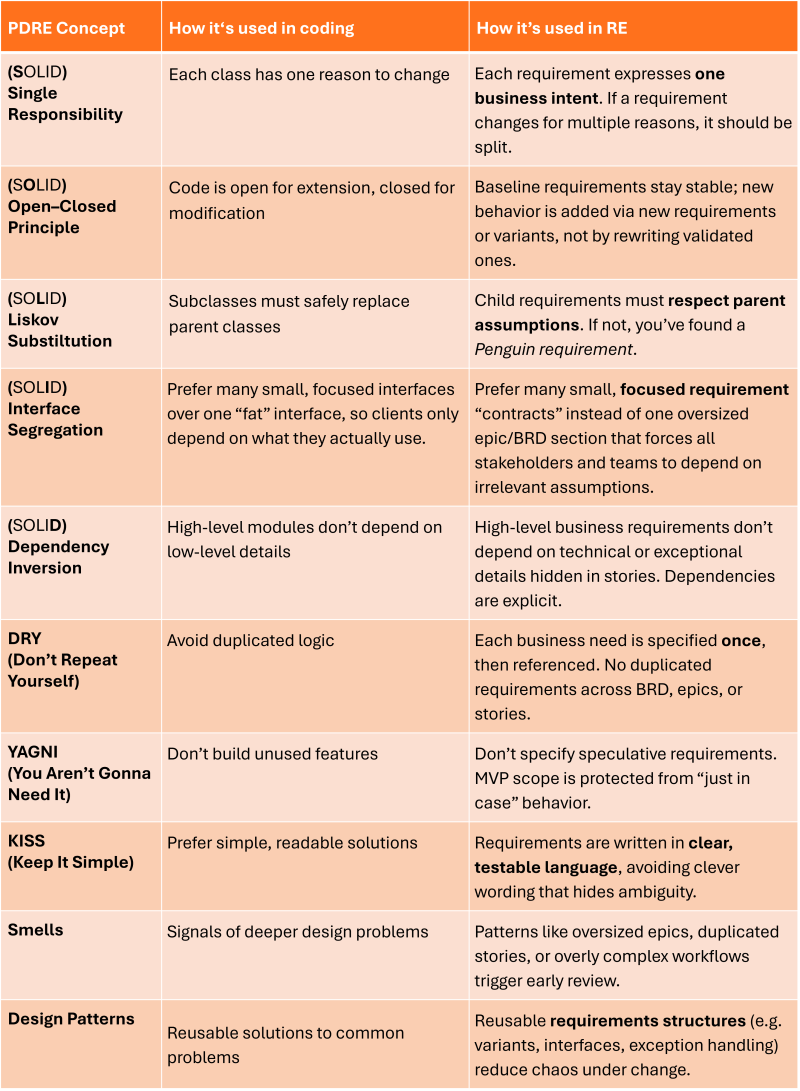
The table below summarizes the PDRE concepts, their well-established use in software design and coding, and how they are systematically adapted and applied as powerful tools in Requirements Engineering.
Context is a fundamental dimension in PDRE and underpins all refinement activities. Every requirement is evaluated against its system boundary, business objectives, stakeholder intent, and external constraints to ensure its relevance and legitimacy. This ensures that requirements are not only well-structured and maintainable, but also contextually valid - i.e., they have a clear “right to exist” within the system under consideration. Concepts such as business smells further rely on this contextual grounding to detect misplaced or unjustified requirements.
3 Requirements quality as a structural concern
One of PDRE’s most important contributions is shifting the discussion of requirements quality away from wording alone and toward structure. In many projects, individual requirements look correct when reviewed in isolation. The problems only emerge when requirements are examined as a set - how they relate, overlap, and depend on one another.
This is where many RE efforts quietly fail. Duplicate requirements describing the same need, oversized user stories covering multiple business intents, and tightly coupled epics that cannot evolve independently all make change expensive and unpredictable. Traceability becomes fragile, validation takes longer, and teams lose confidence in the requirements baseline. If these structural issues are not detected early, they tend to surface later as volatility, rework, and escaped defects.
PDRE addresses this by introducing the concept of business smells. Borrowed from software engineering but translated into requirements language, a business smell is a warning sign, not a defect. It signals that a requirement or a group of requirements deserves closer attention. A requirement that mixes several business goals, for example, may still be implementable, but it will be harder to validate, harder to test, and more likely to change under pressure.
By giving Requirements Engineers a shared vocabulary for these patterns, PDRE makes quality discussions more objective and constructive. Instead of debating opinions or rewriting requirements late, teams can detect structural risks early and correct them while the cost of change is still low. In doing so, PDRE strengthens one of RE’s core missions: maintaining clarity and control as complexity grows.
4 Penguin requirements: misfits in disguise
Some of the most damaging requirements in a project are not the wrong ones - but the ones that almost fit. They pass reviews, raise no objections, and sound perfectly reasonable.
Yet hidden inside them is a broken assumption that slowly destabilizes scope, traceability, and delivery. The PDRE research captures this problem through the idea of Penguin Business Artifacts, inspired by the Liskov Substitution Principle: a penguin is a bird, but it cannot fly. If a requirements model assumes that all birds can fly, failure is only a matter of time.
When translated into Requirements Engineering, this leads to the concept of Penguin requirements. A Penguin requirement is a requirement that appears to belong under a parent artifact - such as a BRD capability, a system requirement, or an epic -but violates one of its core assumptions. The requirement looks correct in isolation, uses familiar domain language, and often aligns with stakeholder expectations. However, it cannot be safely placed under the existing parent model without introducing inconsistency or instability.
What makes Penguin requirements particularly dangerous is their subtlety. They rarely raise red flags during early reviews because they “sound right” and feel reasonable. As a result, they are often accepted without structural analysis. Their true impact only becomes visible later - through repeated requirement changes, unclear acceptance criteria, scope drift, or defects that trace back to broken assumptions.
The concept of Penguin Requirements is closely related to the well-known issue of universal qualifiers in requirements engineering (e.g., “always,” “never,” “all,” “none”). As highlighted in established literature such as Requirements Engineering Fundamentals and review practices like those in Handbook of Walkthroughs, Inspections, and Technical Reviews, such terms introduce risk by assuming that a property applies to all cases, often ignoring real-world exceptions. In PDRE, this idea is extended by framing these cases as a business smell, prompting reviewers to question the validity of such statements (e.g., “Really all?”) and ensure that requirements remain realistic, context-aware, and maintainable.
From an RE perspective, Penguin requirements are not simply incorrect requirements; they are misplaced requirements. If left undetected, they silently undermine requirements quality, weaken traceability, and increase volatility. PDRE’s contribution is making these hidden misfits visible early - when Requirements Engineers still have the opportunity to restructure, isolate, or revalidate them deliberately rather than reactively.
5 A subtle Penguin requirement example (easy to miss)
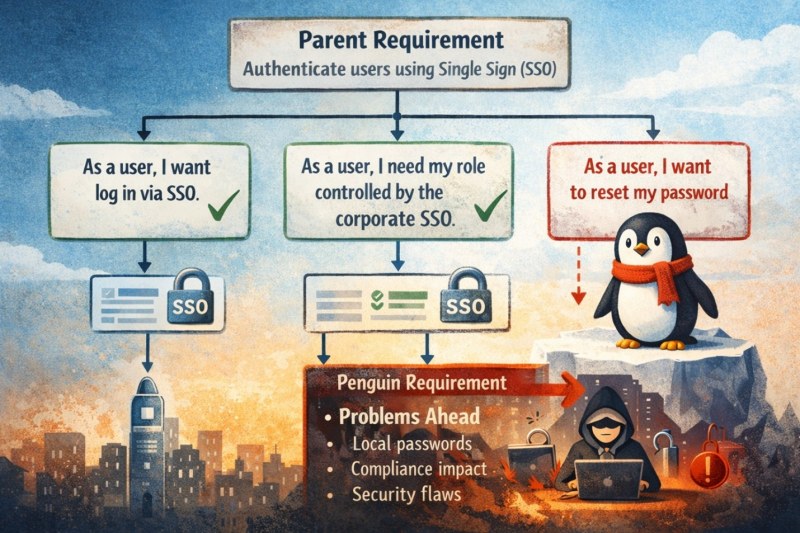
Consider a new Enterprise Resource Planning (ERP) project being implemented in an enterprise, let’s call it Smart Solutions Enterprise (SSE). For the new ERP system, consider the following parent requirement, agreed early and validated with stakeholders:
This requirement carries clear but often implicit assumptions: users are managed centrally, authentication is delegated to an external identity provider, and the ERP system itself does not manage credentials.
During backlog refinement, a new user story is proposed:
At first glance, this requirement seems entirely reasonable. Password reset is common, expected by users, and closely related to authentication. In many projects, it would be accepted without discussion. This is a Penguin requirement, the story breaks a fundamental assumption of the parent epic:
Introducing password reset implies local credential management, additional security requirements, new compliance considerations, and alternative authentication flows. The requirement fits linguistically, but not structurally.
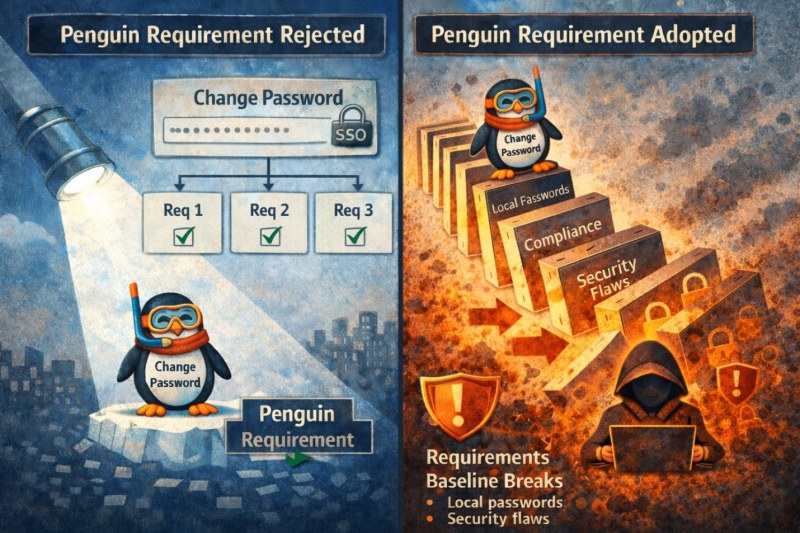
If this Penguin requirement is forced into the existing epic, the effects are gradual but serious. Acceptance criteria become ambiguous, security requirements are silently altered, and teams may implement workaround solutions that contradict the original design intent. What appears as a small usability enhancement turns into scope drift and architectural rework - driven entirely by a misfit requirement.
Again, what makes this a challenging issue is that in such systems it is common to find a “reset password” feature specified, which may initially appear valid and pass early reviews. However, if SSO is defined as an external boundary condition, then password management belongs outside the application scope. In this context, including a “reset password” requirement within the system is not just unnecessary, but contextually misplaced.
This highlights the distinction between:
- Valid external constraints (e.g., SSO governing authentication and password changes), and
- Incorrect inclusion of out-of-scope requirements within the application
Thus, the issue is not the requirement itself, but its misalignment with the defined system boundary, which can lead to confusion and improper design decisions.
From this point on, two paths ahead:
6 How PDRE helps Requirements Engineers respond
PDRE helps Requirements Engineers detect Penguin requirements by encouraging explicit thinking about assumptions and substitution. The key question becomes: Can this requirement be added without breaking the assumptions of its parent artifact?
When the answer is no, PDRE does not reject the requirement. Instead, it forces a clear structural decision. Either the parent requirement is generalized and re-validated to support the new behavior, or the requirement is isolated into a separate “exception interface” - for example, a distinct epic, variant, or future release scope with explicit assumptions.
This approach protects the stability of the existing requirements baseline while making scope decisions visible and deliberate. Penguin requirements are no longer hidden risks; they become managed choices.
7 Evidence from the PDRE pilot
The PDRE research evaluated the approach through three projects within the same business domain, deliberately increasing the level of PDRE adoption from one project to the next. The intent was not to compare different teams or technologies, but to observe how requirements behavior changes as structural discipline is progressively introduced.
The reported results show a clear and consistent trend. In the first project, where PDRE was not applied, requirements volatility reached 80% and defect leakage was 27%. With partial adoption of PDRE principles in the second project, volatility dropped to 53%, while defect leakage decreased to 21%. In the third project, where PDRE was fully applied, requirements volatility was reduced further to 23%, and defect leakage dropped sharply to 6%.
While the study is exploratory and limited in scale, the direction of the results is difficult to ignore. As PDRE practices matured, requirements became more stable, changes became easier to absorb, and fewer defects escaped into later stages of delivery. The findings strongly suggest that requirements structure - not just requirements wording - plays a decisive role in delivery predictability.
For Requirements Engineers, this provides concrete evidence for a belief long held in practice: investing in requirements quality early does not merely improve documentation - it measurably reduces downstream volatility, rework, and defects. In a VUCA environment, this kind of upstream leverage is not optional; it is essential.


8 Conclusion
PDRE is not about adding more process, more templates, or heavier documentation. It is about engineering requirements with intent - treating them as living artifacts that must remain clear, structured, and resilient under change.
The idea of Penguin requirements gives Requirements Engineers something powerful and rare: a simple mental model for a complex problem. It helps identify requirements that look acceptable, pass reviews, and feel familiar - yet quietly violate the assumptions that hold the requirements model together. And this is only one example of what might go wrong in requirements engineering, PDRE adopts software development principles that helps developers maintain and engineer their code efficiently and reflects these concepts into the field of requirements engineering.
By adopting PDRE thinking, Requirements Engineers move from reacting to change to designing for change. Hidden inconsistencies are exposed early, volatility becomes manageable, and scope decisions become explicit rather than accidental. In a VUCA world, this is no longer optional.
9 References
- [1] Maghawry, A., Talaat, Y. (2026). Breaking Field-Specific Silos by Introducing Principle-Driven Requirements Engineering (PDRE) Toward Sustainable Software Quality. In: Silhavy, R., Silhavy, P. (eds) Focus on Artificial Intelligence in Intelligent Systems Design. CoMeSySo 2025. Lecture Notes in Networks and Systems, vol 1901. Springer, Cham. doi.org/10.1007/978-3-032-22236-7_2
- [2] International Organization for Standardization, International Electrotechnical Commission, & Institute of Electrical and Electronics Engineers. (2018). ISO/IEC/IEEE 29148:2018 Systems and software engineering - Life cycle processes - Requirements engineering. ISO.
- [3] International Organization for Standardization & International Electrotechnical Commission. (2023). ISO/IEC 25010:2023: Systems and software engineering - Systems and software Quality Requirements and Evaluation (SQuaRE) - Product quality model (2nd ed.). International Organization for Standardization. iso.org/standard/78176.html.
- [4] Wiegers, K. E., & Beatty, J. (2013). Software requirements (3rd ed.). Microsoft Press.
- [5] Bennett, N., & Lemoine, G. J. (2014). What VUCA really means for you. Harvard Business Review, 92(1/2), 27.
- [6] Barbara Liskov, B. H. (1988). Data abstraction and hierarchy. In Proceedings of the ACM Conference on Object-Oriented Programming Systems, Languages, and Applications (OOPSLA) (pp. 17–34).
- [7] Freedman, D. P., & Weinberg, G. M. (1990). Handbook of walkthroughs, inspections, and technical reviews: Evaluating programs, projects, and products. Dorset House Publishing.
- [8] Pohl, K., & Rupp, C. (2021). Basiswissen Requirements Engineering: Aus- und Weiterbildung nach IREB-Standard zum Certified Professional for Requirements Engineering Foundation Level (5th ed.). dpunkt.verlag.
Ahmed M. Maghawry is a multidisciplinary technology leader and university lecturer with a background spanning software engineering, requirements engineering, product ownership, and technical product management as well as business analysis. He is a cybersecurity expert and scientific researcher with an MSc and PhD in Artificial Intelligence, complemented by an MBA focused on fintech and blockchain, and he is currently pursuing a DBA in digital transformation.
Ahmed has conducted extensive Software Engineering and AI research, with growing interests in applying technology to environmental sustainability and impact-driven innovation. He is certified cyber security analyst and brings hands-on industry experience as a former full-stack software developer, bridging deep technical execution with product strategy and research excellence.