Neil Maiden
Using AI to discover more innovative requirements from documents
Revisiting models of creativity for AI
This article demonstrates how to increase the novelty of innovation opportunities generated by AI without losing their usefulness. Drawing on established models of creativity, the article introduces the concept of opportunity spaces that can be discovered, defined and explored automatically using a combinational of text processing, machine learning and generative AI technologies. The article also summarises an evaluation that revealed that this approach generated more novel and useful innovation opportunities than equivalent uses of ChatGPT4o and Notebook LM. It provides accessible references and simple recommendations to follow.
Inventing requirements
Over the last three decades, requirement engineering practices for software-based systems have evolved from eliciting and acquiring requirements to surfacing [Anton & Potts 1998] then inventing them [Maiden et al. 2004, Giunta et al. 2022]. Many creative thinking processes (e.g., [Maiden & Robertson 2005]), techniques (e.g., [Michalko 2006]) and digital tools (e.g., [MacNeil et al. 2021]) now exist to invent requirements. However, the generative AI technologies that have become widely accessible since November 2022 have the potential to transform this invention process further.
This article describes how these generative AI technologies can be integrated with natural language processing and machine learning techniques to invent more novel and useful opportunities from large volumes of information in documents such as problem reports, market analyses and systems specifications. This information typically resides in different document formats with diverse structures, and can even be expressed in different languages. The article references existing creativity models recently operationalised by my team in a new computational model of creative outcomes.
The remainder of the article is in six sections. The next two summarise some of the limitations of generative AI when applied to innovation, and selected creativity models that can inform more effective use of AI technologies when applied to innovation work. The article then introduces the importance of what I call opportunity spaces, before describing how generative AI techniques can be applied to discover more innovative opportunities in these spaces. It then summarises a recent comparison of ratings of novelty and usefulness of innovation opportunities generated using this approach against opportunities generated using OpenAI’s GPT4o and Google’s Notebook LM. The article ends with conclusions and future steps in my team’s work to innovate with AI.
Innovating with generative AI
In simple terms, Generative Pre-trained Transformer (GPT) neural networks seek to predict accurate sequences of words for input text prompts using Large Language Models (LLMs) trained on massive language datasets. Implementations such as GPT-5 can create potentially innovative requirements by manipulating large volumes of information from beyond organisational boundaries, and chatbots allow stakeholders to interact naturally with these implementations to explore requirements. Chatbot uses in business contexts have been shown to support consultants to generate more ideas (e.g. [Bouschery et al. 2023]) and deliver higher quality results (e.g., [Dell’Acqua et al. 2023]).
However, questions remain about GPT capabilities to explore radically new spaces of ideas (e.g., [Franceschelli & Musolesi 2023]). These questions are supported by empirical findings. E.g., although generative AI use enhanced creative thinking by offering new possibilities [Doshi & Hauser 2023] and exploring larger ideas spaces [Bouschery et al. 2023], it also reduced the collective novelty of these possibilities [Doshi & Hauser 2023] and led to higher fixation on examples as well as fewer solutions with lower originality compared to a baseline [Wadinambiarachchi et al. 2024]. Indeed, generative AI ideas often trade-off novelty for usefulness [Si et al. 2024], and little evidence for generative AI producing more radically novel outcomes has been published.
Of course, it is perhaps unsurprising that generative AI fails to produce more radically creative outcomes. After all, its development has not been informed by any of the established models of creativity, even though creative thinking is an acknowledged pre-requisite for innovation. In the next section I explore some of these creativity models from an information processing perspective.
What models of creativity tell us
Numerous models of creative processes and outcomes have been published. Most define creative outcomes such as innovation opportunities as being both novel and useful for specified tasks [Sternberg 1999]. Our work adopted this definition – innovation opportunities are creative outcomes that are both novel and useful for a task.
Structuralist models of creative processes and outcomes are particularly relevant to the application of AI technologies that are developed to produce creative outcomes [Shneiderman 2007]. These models emerged from information processing theories to describe innovation opportunities in terms of the information manipulated to generate them. This focus on the manipulation of information about these innovation opportunities (referred to as opportunities in the remainder of this article) provides a perspective with which to think more deeply about using AI technologies for innovation work.
Structuralist models often define creative problem solving as iterations of discovering divergent then convergent opportunities that explore spaces of larger numbers of less complete opportunities then fewer but more complete ones [Plsek 1997]. Within this framing, Boden [1990] distinguished between two types of creativity – exploratory and transformational. Exploratory creativity assumes a defined conceptual space of partial and complete opportunities to explore – a space that also implies the existence of rules that define the space. Changes to these rules produce what might be thought of as a paradigm shift, called transformational creativity [Boden 1990]. Opportunities that are novel and useful are reached in each space by what are called generative rules [Boden 1990]. Different rules discover more divergent and convergent opportunities and are often operationalised as guidance within creative thinking techniques such as SCAMPER [Serrat 2017]. One specific form of exploratory creativity, called combinational creativity, makes unfamiliar connections between familiar items in the pre-defined search space, using a different set of generative rules [Boden 1990].
Building on these conceptual spaces, innovation opportunities have also been defined in the context of a need not fulfilled by existing solutions (i.e., opportunities that have already been discovered) in the same class [Gero 2000] [Maher & Fisher 2011]. An incomplete set of known solutions for a class can define the space of yet-to-be-discovered partial and complete opportunities for it, and the relative novelty of each opportunity can be measured by how different it is from the set of known solutions, often measured by the distance between it and the centroid of the nearest cluster of solutions for that class [Maher & Fisher 2011]. In traditional requirements projects, this is equivalent of exploring solution spaces for opportunities with the potential to innovate further in both the requirements and architecture spaces [Nuseibeh 2001]. Returning to Boden [Boden 1990], discovering opportunities furthest from the centroid of each conceptual space defined by a class can result in more novel innovation opportunities using an exploratory creative thinking style.
In this article, I argue that these creativity models provide a valuable framework with which to think about AI tools to discover more novel but still useful innovation opportunities (and hence the user and system requirements that can be derived from these opportunities), thereby overcoming the novel-useful trade-off reported with LLMs [Si et al. 2024]. This framework states that these opportunities are discovered using generative rules that explore predefined opportunity spaces. These spaces are bounded by existing solutions (the already discovered opportunities) to different classes of need, and more novel opportunities in these spaces are semantically further from its centroid, but still within the boundaries of that space.
To demonstrate the framework, consider a simple example from smart home systems. Many of these systems already provide solutions (i.e., previously discovered innovation opportunities) that make homes more secure, control their energy use, and manage their diverse household appliances. In its simplest form, each of these existing classes could be associated with one different space of innovation opportunities, as depicted visually in Figure 1.

Three of the opportunities in the space for controlling energy use are labelled A, B and C. Opportunity A has a shorter distance to the centroid of the space than do B and C, so A is the least novel, and hence is the least creative of the three. One such opportunity might be automatic scheduling of appliance use based on a weekly plan. Opportunities B and C both have larger but similar semantic distances from the centroid, so both have higher potential novelty than A. These opportunities might include condition-based maintenance and self-diagnosis of appliances that continuously monitor their internal components. Each of these opportunities in the space can be discovered using different generative rules. Examples of these rules codify established creative thinking techniques such as SCAMPER [Serrat 2017] and Assumption Busting [Michalko 2006]. Furthermore, opportunities can also be discovered in spaces that intersect two or more spaces. These combinational opportunities are potentially more useful than others as they address multiple needs, and are also more creative because of their greater semantic distances from the centroids of each space. E.g., the opportunity D in Figure 1 exists at the intersection of the appliance and energy use spaces, and might include AI-driven energy–appliance orchestration.
In my team’s experiences, discovering and defining effective opportunity spaces using current generative AI technologies, e.g., by building a LLM from project-specific documents, can be difficult. This is perhaps unsurprising because LLMs are unsuited to such a task. Their reliance on run-time probabilistic manipulation of language tokens, even when models are generated from project documents, risks over-fitting when discovering clusters that equate to spaces of useful opportunities. These experiences reflected the limitations of LLMs reported earlier – that reduced the collective novelty of opportunities [Doshi & Hauser 2023] and often traded off opportunity novelty for usefulness [Si et al. 2024]. It became clear that other more deterministic approaches better suited to the task were needed. The next two sections summarise one alternative that has been evaluated positively with documents of types typically available to innovation projects.
Discovering innovation opportunity spaces
Project documents often harbour innovation opportunities that are difficult to uncover. These documents can be problem reports, market analyses, consumer feedback documents, competitor analyses and relevant patents, as well as current and previous system specifications. Indeed, the more diverse the documents and their sources, the greater the increase in the potential number of opportunity spaces.
A first task is to extract information from relevant documents. My team’s experiments with automated extraction procedures have revealed that text can be extracted effectively from different file types (e.g., from PDF, HTML and image files using optical character recognition) using established python libraries such as pdftotext and pypdf for PDF files, pytesseract and pdf2image for OCR recognition, docx2python for MS Word files, python-ppt for MS PowerPoint files and html2text for HTML files. Simple text cleaning algorithms can then be applied to the outputs to, e.g., remove extra spaces and standardise characters, and if text is written in languages other than English, it can be translated using established services such as DeepL [DeepL 2025]. Your project text is then ready to be processed to uncover different spaces of innovation opportunities.
Topic modelling is a form of statistical modelling that uses unsupervised machine learning to discover clusters of similar words within a text corpus. BERTopic software [BERTopic 2025] was chosen to undertake this topic modelling because of its reliability and scalability with incomplete and unstructured information. It implements UMAP to reduce the dimensionality of text embeddings, HDBSCAN to cluster the reduced embeddings, then class-based TF-IDF to extract and reduce topics, and Maximal Marginal Relevance to improve the coherence of words. As a consequence, semantic structures in the text are used to cluster unstructured data without predefined tags, training data or user intervention. To direct the modelling, parameter values can be set manually to reflect the file sizes, numbers and content types in the documents.
Experiences with innovation projects by my team revealed that equating generated clusters with opportunity spaces was effective for subsequent opportunity generation. Each space is defined as a multi-dimensional space of information pieces expressed as topic terms, in which more similar pieces are closer together. Again, the experiences from projects revealed these terms defined effective inputs to generative rules to discover opportunities in each space. E.g., topic terms for the space of opportunities for managing household appliances could include interconnectivity and predictive maintenance – useful seeds for the generative rules. Furthermore, to increase choice for discovering opportunities, the topic modelling can be directed to generate opportunity spaces of different sizes for each set of input assets, e.g., based on feedback on model outcomes from innovation consultants, between four and eight spaces or between 15 and 30 spaces. What is more, natural language descriptions of each discovered opportunity space can then be generated from the ordered topic terms. One obvious approach is to invoke an API call to GPT-5 to generate descriptions of all opportunity spaces in a single request. The output from this simple step is a short label and 100-word description of each space and its distinguishing characteristics. The word length was set with consultants to balance between readability and detail. The GPT prompt called by the operation is depicted in Figure 2.

For example, application of this prompt to topic terms that describe solutions for managing energy uses at home generates a description entitled Smart home energy landscape with the following description 100-word description:
This area is a technologically coordinated zone focused on improving household energy performance through smart home automation, real-time analytics, and predictive control. It integrates HEMS, smart thermostats, zonal heating and cooling, and occupancy-based control to optimize usage while maintaining comfort. Load monitoring, appliance scheduling, and smart metering support peak load shaving, standby power reduction, and power consumption forecasting. DER integration and renewable energy utilization enhance resilience and sustainability. Insulation optimization, lighting controls, and behavioural nudging help residents reduce waste and manage costs through intuitive, data-driven adjustments that promote long-term efficiency and encourage smarter everyday energy decisions in the modern home.
Our experiences revealed that this form and length of opportunity space description was effective to consultants to make decisions about which spaces to explore for innovation opportunities.
Discovering innovation opportunities in opportunity spaces
Multiple generative rules can then be applied to discover opportunities of different types in selected opportunity spaces. Each rule is codified as a bespoke parameterised operation that manipulates multiple inputs to populate a bespoke GPT-5 prompt via an API and generate opportunities. Different rules discover different types of opportunities. E.g., business-type opportunities build on ideas that can support organisations to innovate, policy-type opportunities build on ideas that policy makers can implement to improve people’s lives, and technical design opportunities build on ideas related to the development and application of different technologies. Different rules also seek to seek opportunities that result from transformational, exploratory and combinational creative processes. An example of one simple generative rule – to discover business-type opportunities in one opportunity space – is presented in Figure 3, with input variables shown in bold. Inputs include the 100-word description of the opportunity space, the user-selected novelty setting, and topic terms selected automatically based on the selected novelty setting. E.g., to generate more prototypical opportunities in a space, randomly selected topic terms with higher weightings that indicating centrality to the space are used. On the other hand, to generate highly unusual opportunities, the rule is seeded with lower-weighted topic terms that are further from the centre of the space, but because all possible opportunities still exist with the defined opportunity space, these opportunities remain potentially useful.

To demonstrate this rule and prompt, two of the 10 business opportunities generated further from the centroid of the earlier opportunity space without custom text and selected creative qualities are:
- Weather-morphing comfort zones:
A predictive comfort engine that dynamically reshapes heating and cooling zones based on hyperlocal weather evolution, user routines, and thermal drift forecasts. Beneficiaries include smart thermostat vendors, HVAC installers, and multiroom system providers. Outcomes include sharper comfort control, lower energy swings, and gamified user engagement. Implementation uses zonal sensors and cloud forecasts to autonomously shift heating priorities and lighting warmth profiles. - Adaptive electrification habitat pods:
Modular, room-sized pods retrofitted inside homes to create ultra-efficient microhabitats optimised for weather-adaptive heating, cooling, lighting, and appliance control. Markets include dense urban regions, elderly-care environments, and high-cost retrofitting areas. Outcomes include targeted electrification benefits without full-home renovations. Implementation uses prefabricated shells with embedded HEMS modules, leased or subscription-installed like furniture.
Each of the opportunities is novel because the rule requests highly unusual opportunities centred on topic terms that are peripheral rather than central to the space. At the same time, each opportunity is still useful because the topic terms are still within the space of possible opportunities.
The current version of the computational model has over 30 equivalent rules too numerous to repeat here that reflect different features to control opportunity generation, e.g., to generate opportunities of different types, within opportunity spaces, and the intersections of spaces, in new spaces framed by existing spaces, and by pivoting around discovered opportunities. Note that the effectiveness of these rules is not due to increasingly sophisticated prompt engineering, but on the coverage and descriptions of the opportunity spaces input to them, generated using other techniques.
Evaluating the value of opportunity spaces
To explore its relative effectiveness, the approach was implemented in a bespoke interactive tool called INSIGHTS and compared to two LLM-based tools often used for innovation work. The first was Google’s Notebook LM, a tool that grounds language models in user-provided documents to create a personalized LLM. The comparison to INSIGHTS was obvious – both generated guidance including opportunities based on information extracted from a set of uploaded documents. The second general-purpose tool was Open AI’s ChatGPT-4o. Anecdotal evidence suggested that many innovation consultants use its basic chat function to generate opportunities with which to innovate during projects, hence the comparison to the document-specific Notebook LM. More information about INSIGHTS [INSIGHTS 2025] and full details of the evaluation are available at [Maiden et al. 2025b].
A new project in INSIGHTS was set up with nine PDF documents written in English and reporting different aspects of UK and related hospitality sectors. Each document was publicly available and discovered using a Google search. The shortest was six pages long, the longest 55 pages. The same nine documents were uploaded into Notebook LM to generate a local LLM. By contrast for the reasons stated above, the comparison with GPT4o used its public model – no information assets were uploaded.
Different permutations of a request for seaside towns to regenerate by attracting new investment linked to new areas of growth were applied to generate over 4000 opportunities. Each opportunity was described in text with a label and a 100-word structured description. The novelty and usefulness of each of these opportunities were rated on a 1-7 scale using a different sophisticated GPT4o prompt. These novelty and usefulness rating provided the data for the comparative evaluation.
Results revealed the relative effectiveness of the implemented approach compared to the two LLM-based implementations. Overall averages of the novelty and usefulness ratings of opportunities on 1-7 scales generated by INSIGHTS using the baseline request, and by Notebook LM and ChatGPT4o with the equivalent prompts are presented in Table 1. These averages revealed that INSIGHTS generated policy, business and technical design opportunities that were both relatively novel (6+ out of 7) and useful (5.8+ out of 7).
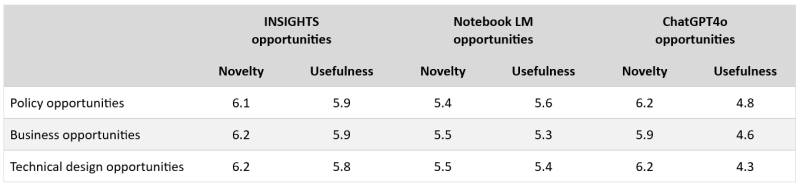
Comparing opportunities generated by INSIGHTS with the baseline request and Notebook LM, Mann-Whitney tests revealed significant differences in their novelty ratings (z=4.6448, p<.00001) and usefulness ratings (z=4.8593, p<.00001). Overall, the analysis revealed that INSIGHTS generated more creative, i.e., more novel and more useful business opportunities and technical design opportunities than Notebook LM. Comparing the opportunities generated by INSIGHTS and ChatGPT4o, Mann-Whitney tests revealed a significant difference in their opportunity usefulness ratings (z=8.538, p<.00001) but no significant differences in opportunity novelty ratings (z=0.2775, p=.3897). The analysis revealed that ChatGPT4o generated opportunities of different types that were as novel as INSIGHTS with the baseline request, but these opportunities were significantly less useful and hence creative than those generated by INSIGHTS.
Overall, this evaluation demonstrated the value of discovering and defining spaces of opportunities prior to discovering more novel but still useful opportunities in these spaces. Our implementation of a computational model of creative outcomes, based on established creativity models, enhanced the novelty of innovation opportunities without trading off opportunity usefulness (e.g., [Si et al. 2024]. Moreover, additional model functions described in [Maiden et al. 2025b] further increased opportunity novelty, revealing the potential of the model and approach.
Conclusions and takeaways
This article makes the case that generative AI approaches to discovering innovation opportunities for requirements and other types of projects using LLMs and traditional forms of prompt engineering is sub-optimal. This claim should be unsurprising, given the increasing number of studies (e.g., [Doshi & Hauser 2023]) that demonstrate only incremental novelty. Both foundational and local LLMs are ill-suited to describing and manipulating different spaces of innovation opportunities defined in established theories and models of creative outcomes (e.g., [Boden 1990, Maher & Fisher 2011]). The evaluation demonstrated that innovation opportunities generated using LLMs are less novel and/or useful than is possible with AI technologies.
Instead, the article reports an alternative approach – one implemented in a computational model on creative outcomes founded of well-defined spaces of innovation opportunities with specific properties. The implementation of this model uses multiple technologies – text extraction and parsing and machine learning – to define these opportunity spaces more deterministically than with generative AI. According to creativity theories and models, opportunity spaces are critical to the success of innovation processes. Each individual space bounds and directs innovation work, and the collection of spaces frames each project’s innovation potential. In requirements projects, these spaces define where more innovative opportunities are most likely to be found.
Although implemented in our bespoke INSIGHTS tool, the computational model also provides more general guidance for professionals seeking more innovative opportunities from sets of project documents. To end the article, I summarise four pieces of this guidance here:
- Use other digital tools in the public domain apart from LLMs to extract all text from your project documents, to provide the strongest baseline for uncovering spaces of opportunities.
- Apply topic modelling such as BERTopic [2025] to uncover opportunity spaces from document text and the terms that describe them accurately. If not, develop bespoke LLM prompts to the texts to approximate these terms and their relative descriptiveness.
- Build your own set of advanced generative rules for discovering opportunities of different types in different areas of opportunity spaces (e.g., product innovation or business consulting), either as complex LLM prompts or pre-programmed creative searches for internet content.
- Feed more innovative opportunities that you discover back into your process, to discover even more innovative ones close to in the same space.
If you want more information about INSIGHTS, go to the website [INSIGHTS 2025], which provides more information about the approach as well as case studies reporting how professionals have used it in different sectors. My team are continuing to develop the approach, the computational model and its INSIGHTS implementation, and will share more insightful findings when available.
References
- Anton, A. & Potts. C. (1998). The Use of Goals to Surface Requirements for Evolving Systems. Proc. 19th IEEE International Conference on Software Engineering, IEEE Computer Society Press.
- BERTopic (2025). maartengr.github.io/BERTopic/index.html.
- M. A. Boden (1990). The Creative Mind, Abacus, London.
- Bouschery, S.G., Blazevic, V., & Piller, F.T. (2023). Augmenting human innovation teams with artificial intelligence: exploring transformer-based language models.” Journal of Product Innovation Management 40(2): 139– 153. doi.org/10.1111/jpim.12656
- DeepL (2025). www.deepl.com/en/translator.
- Dell'Acqua, F., McFowland, E., Mollick, E.R., Lifshitz-Assaf, H., Kellogg, K., Rajendran, S., Krayer, L., Candelon, F. and Lakhani, K.R. (2023). Navigating the Jagged Technological Frontier: Field Experimental Evidence of the Effects of AI on Knowledge Worker Productivity and Quality (September 15, 2023). Harvard Business School Technology & Operations Mgt. Unit Working Paper No. 24-013.
- Doshi, A.R. & Hauser, O. (2023). Generative Artificial Intelligence Enhances Creativity but Reduces the Diversity of Novel Content. SSRN 4535536. doi.org/10.2139/ssrn.4535536.
- Franceschelli, G. & Musolesi, M. (2023). On the Creativity of Large Language Models. arXiv:2304.00008 [cs.AI].
- Gero, J.S. (2000). Computational Models of Innovative and Creative Design Processes, Technological Forecasting and Social Change, 64 (2–3), Pages 183-196, ISSN 0040-1625, doi.org/10.1016/S0040-1625(99)00105-5.
- Giunta, B., Burnay, C., Maiden, N. & Faulkner, S. (2022). Creativity triggers: extension and empirical evaluation of their effectiveness during requirements elicitation. Journal of Systems and Software 191, 111365, ISSN 0164-1212. doi.org/10.1016/j.jss.2022.111365
- INSIGHTS (2025). Unlock your innovation potential with INSIGHTS. insightsinnovate.io.
- MacNeil, S., Ding, Z., Quan, K., Parashos, T. J., Sun, Y. & Dow, S.P. (2021). Framing Creative Work: Helping Novices Frame Better Problems through Interactive Scaffolding. In Proceedings of the 13th Conference on Creativity and Cognition (C&C '21). Association for Computing Machinery, New York, NY, USA, Article 30, 1–10.
- Maher, M.L. & Fisher, D. (2011). Using AI to Evaluate Creative Designs. DS 73-1 Proceedings 2nd International Conference on Design Creativity, Volume 1, 45-54.
- Maiden, N., Gizikis, A. & Robertson, S. (2004). Provoking creativity: imagine what your requirements could be like. IEEE Software 21(5), 68-75. doi: 10.1109/MS.2004.1331305.
- Maiden, N. & Robertson, S. (2005). Integrating creativity into requirements processes: experiences with an air traffic management system, 13th IEEE International Conference on Requirements Engineering (RE'05), Paris, France, 2005, 105-114. doi: 10.1109/RE.2005.34.
- Maiden, N., Zachos, K., Petrianakis, K., Lockerbie, J., Chanpalangsri, C., Ernst, H. & Kara, S. (2025a). Beyond Just Generative AI for Discovering Software Opportunities," IEEE Software 42(3), 41-49, May-June 2025. doi.org/10.1109/MS.2025.3540672.
- Maiden, N., Zachos, K., Lockerbie, J., Petrianakis, K. & Brown, A. (2025b). A computational model and tool for generating more novel opportunities in professional innovation processes. arXiv:2510.20402 [cs.AI], doi.org/10.48550/arXiv.2510.20402.
- Michalko, M. (2006). Thinkertoys: a handbook of creative-thinking techniques. Ten Speed Press, 2nd Edition.
- Nuseibeh, B. (2001). Weaving Together Requirements and Architectures. Computer 34(3), 115-117. doi.10.1109/2.910904.
- Plsek, P. (1997). Creativity, innovation and quality. ASQ Quality Press
- Serrat, O. (2017). Knowledge solutions: tools, methods, and approaches to drive organizational performance. Springer-Nature.
- Shneiderman, B. (2007). Creativity support tools – accelerating discovery and innovation, Communications of the ACM 50(12), 20-29. doi.org/10.1145/1323688.1323689.
- Si, C., Yang, D., & Hashimoto, T. (2024). Can LLMs Generate Novel Research Ideas? A Large-Scale Human Study with 100+ NLP Researchers. arXiv:2409.04109 [cs.CL]. doi.org/10.48550/arXiv.2409.04109.
- Sternberg, R.J. (Ed.), 1999. Handbook of creativity. New York. Cambridge University Press.
- Wadinambiarachchi, S., Kelly, R.M., Pareek, S., Zhou, Q. & Velloso, E. (2024). The Effects of Generative AI on Design Fixation and Divergent Thinking. Proceedings CHI Conference on Human Factors in Computing Systems (CHI '24). Association for Computing Machinery, New York, NY, USA, Article 380, 1–18. doi.org/10.1145/3613904.3642919.
Neil Maiden is Emeritus Professor at City St George’s, University of London. His interest is artificial intelligence to augment human creativity. He has published over 200 peer-reviewed papers, chaired the Steering Committee for the IEEE International RE Conference and edited the IEEE Software’s Requirements column from 2005 to 2013.